
Equipping Leaders Heading

KEYNOTES - TRAINING - COACHING

Copy of Stop Motivating Header
As Seen on Tv Dr Jason Jones

END STAGNATION. ACTIVATE POTENTIAL.

Roughly 70% of employees are disengaged, lack motivation, and perform far below their potential. This widespread stagnation is one of the greatest drags on business results—and a major source of stress for leaders.

Neuroscience shows that the root of this problem is dormant brainpower: the untapped energy and drive within people that goes unrealized. Unfortunately, most leaders lack the understanding and skill to help their people move beyond average.

When leaders learn and apply neuroscience-based principles—focused on the daily practices of connecting, coaching, and culturing—people flourish. They engage more deeply, contribute more meaningfully, and often exceed their own expectations. Leaders who activate this potential not only elevate performance, they build healthier, more energized teams ready to thrive in today’s demanding workplace.


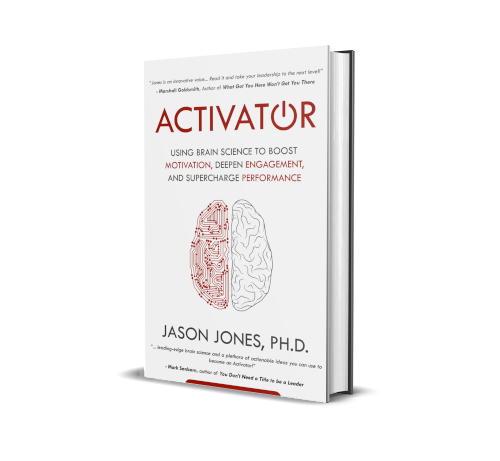
Get Your Copy Today!

Activate Book Cover 500x500

"Jason is an innovative voice in our new world of work."

- Marshall Goldsmith

TRUSTED BY

Copy of Client List 2-2-23 (1366 × 700 px)

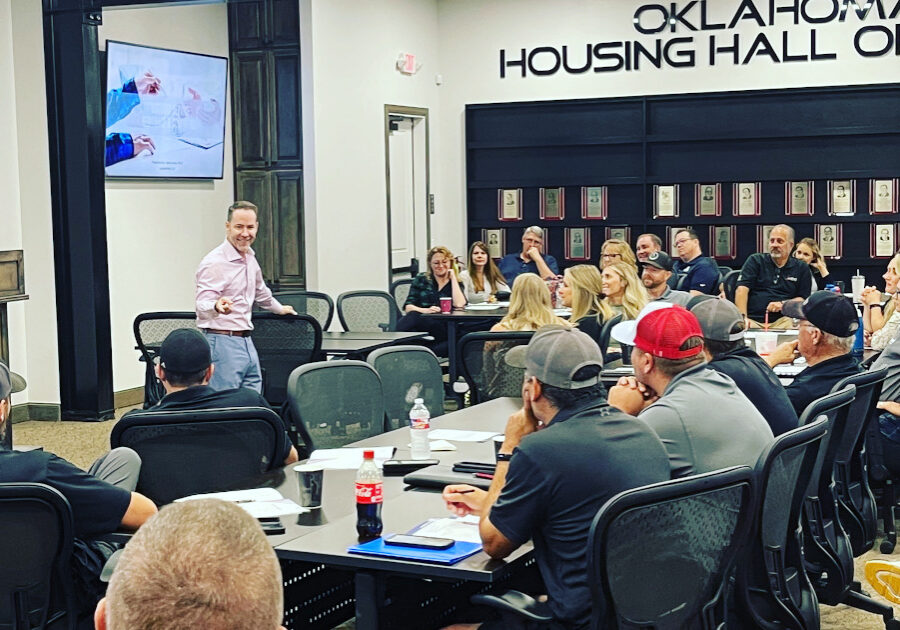
Engaging and inspiring keynote messages that include practical and proven methods to move your people to do more and be more. 

Innovative and challenging leadership training programs that focus on building mindsets and skillsets to be more effective and perform at a high level. 

Learn more about Jason's books and leadership resources that can help you activate the natural energy of others.

Download Your Free Copy!

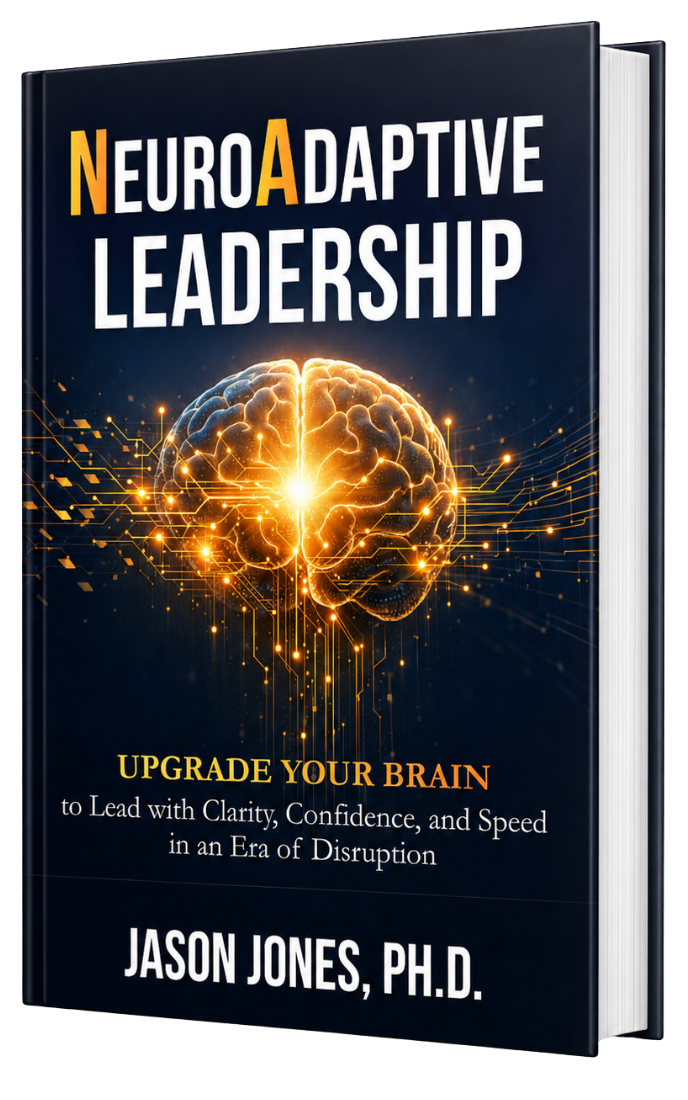
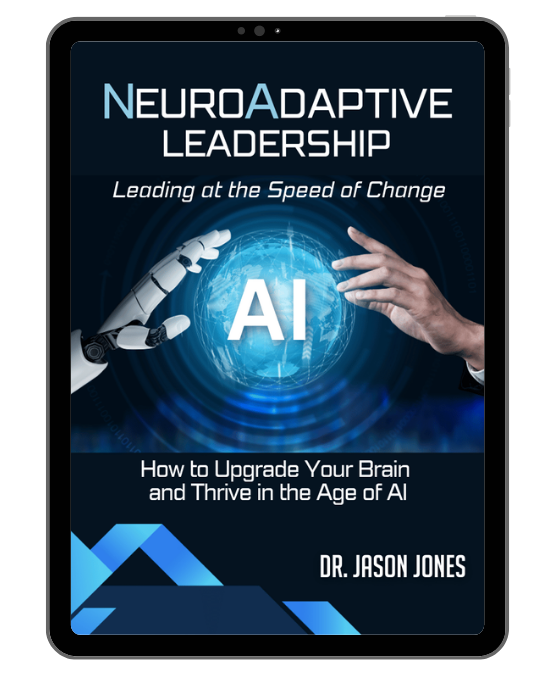
NeuroAdaptive Leadership Mock Up

NeuroAdaptive Leadership Report

How to Upgrade Your Brain and Thrive in the Age of AI. 

The pace of disruption has never been faster—and AI is rewriting the rules of business and leadership. The leaders who will excel in this new era aren’t just adopting new tools; they’re rewiring their brains for sharper thinking, faster adaptability, and deeper human connection.

In this report, Dr. Jason Jones reveals the neuroscience-backed strategies that today’s top leaders are using to:

  • Stay calm and clear under pressure.

  • Make fast, ethical decisions in uncertainty.

  • Build trust and influence in AI-augmented teams.

  • Reframe setbacks into strategic opportunities.

  • Strengthen mental agility to adapt in real time.

  • Harness stress as a performance advantage.

NeuroAdaptive Leadership gives leaders the inner upgrade external strategies can’t.

- Dr. Jason Jones

ARTICLES & VIDEOS

The study of human behavior and motivation is fascinating. For centuries people have sought to better understand what drives us. Read more
Just about every framework of employee motivation tells us that a sense of meaning and purpose is what drives this Read more
Most people believe motivation is a process by which one person instills energy into another. This is why so many Read more
Motivation is one of the most interesting topics to people because it is at the root of our behavior, values, and personality.   Read more
For centuries people have contemplated the origins of what motivates people. Before the term motivation was created, people just wanted Read more
In our fast-paced work environment it is difficult to find time to give focused attention to the things that require Read more
I was recently interviewed by Ryan Estis, noted performance and leadership expert, for a post on his blog. Ryan has Read more
A coaching leader uses many different tools and techniques to help people move toward achieving their goals. I have already Read more
In a prior post I shared a coaching framework called the GOAL model to help leaders know the steps and Read more

The 16 Drivers of Meaning & Motivation

The study of human behavior and motivation is fascinating. For centuries people have sought to better understand what drives us. Many have attempted to create a taxonomy of motivation drivers, desires, values, or motives that are basic to every human. Up until recently, attempts to do so have been educated guesses and theory.

The research of Stephen Reiss and Susan Haverford over the past several years has created the clearest understanding of the things we all desire, what we value, and therefore what motivates our behaviors. Their process of confirmatory factor analysis using data from people all over the world created a list of 16 basic desires. Each desire is statistically unique ( it does not overlap in meaning with the other 15 desires), universal (all humans have the desire), and intrinsic (internal drive that provides a sense of meaning). Below I have listed the 16 basic desires.

Acceptance – The desire to be accepted and to avoid criticism

Beauty – The desire to be in aesthetically pleasing environments

Curiosity – The desire to learn and understand

Eating – The desire for food

Expedience – The desire to act with self-interest

Family – The desire to raise children and spend time with family

Idealism – The desire to improve society

Interdependence – The desire to work with others to meet one’s needs

Order – The desire to be clean and organized

Physical Activity – The desire for physical movement and exercise

Power – The desire to lead and influence others

Saving – The desire to conserve and collect

Social Contact – The desire to be with people

Status – The desire for prestige and social standing

Tranquility – The desire to avoid stress and anxiety

Vengeance – The desire to confront others when offended and for competition

Every person embraces each of these desires but at different intensity levels ranging from weak to strong. Each person can be driven by multiple desires at one time, although they do compete for priority status. A person’s combination of intensity level for each desire makes us all unique. Any given person will have only an average level of intensity for most of the desires. It is the desires that are weak or strong in intensity that most drive motivation and focused behaviors to enable satisfying the desire. These behaviors become our personality traits and the desires mold our sense of meaning.

It is true. What gives us a sense of meaning and purpose does motivate. Understanding what desires drive our meaning and values can help us better position ourselves to be more motivated and satisfy our desires. When this happens we live with a greater sense of meaning, positive motivation and fulfillment.

Because desires are only satisfied for a short time, people are motivated by pursuing goals and activity that lead toward fulfilling the desire. Leaders can utilize this taxonomy to better understand the activities and environment a person can be put in to be more motivated and satisfied.

Motivating leaders give people opportunities to support and move toward fulfilling their deepest desires and values. This not only helps people feel valued and understood, it also helps people feel a sense of meaning and purpose on the job.


How Meaning Really Motivates

Just about every framework of employee motivation tells us that a sense of meaning and purpose is what drives this precious internal energy.  There is no doubt that this explanation is solid and has scientific proof. The problem I see is not the concept of meaning driving motivation, but the advice most authors, speakers, and trainers give for how to help a person make meaning and connect to his or her purpose while on the job.

A person’s sense of meaning and purpose can only be defined by that person. It is not organizational mission, vision, program, or a set of values that give a person meaning or purpose. Rather, it’s the connection between a person’s internal sense of meaning and purpose with the organization’s sense of mission, vision, and values that can activate the motivation.

It seems easy to create this connection with employees since we assume we know what gives people meaning and purpose in life. However, recent research tells us that people find meaning and purpose in differing ways. There are many factors that drive our sense of meaning, purpose, and ultimately what we value.

Believe it or not, there are people who find purpose in building wealth over altruistic endeavors. I know we don’t like to think this is true, but it is. There are many who find meaning in tranquility and relaxation, while others are bored to tears or feel lazy pursuing these activities.

Some find meaning and purpose in saving and conserving resources while others find moderate or no meaning in these endeavors. Some find meaning in the continual pursuit of learning and understanding and others find it lacks fulfillment.

A popular myth of motivation is that we are all highly motivated by personal growth, social justice, or family-oriented activities. Many do find great meaning and sense of purpose in these, yet not all do.

Dr. Stephen Reiss of Ohio State University has spent the past two decades investigating the internal drivers of motivation. Through valid assessment of thousands of people around the world, his studies have derived 16 basic desires that drive our motivations, values, behavior, personality traits and sense of meaning and purpose.

Reiss and his colleague Susan Haverford’s investigated 320 desires that made up a base-line of possible human drives that would explain motivation. Through a process of confirmatory factor analysis this list was reduced to 16 motives that are significantly different than one another, are consistent across cultures, and have psychological significance. Here is the list of the 16 desires.

To truly appeal to each person’s sense of meaning and purpose, leaders must not overgeneralize what constitutes meaning to a group of people. Secondly, leaders must become familiar with each employee to better understand what is meaningful to that person and appeal to this meaning within the work environment. This may even involve moving a person to a job that better aligns to the person’s values and enables the person to better pursue his/her basic desires.

In my next post, I’ll share the 16 Factors that drive intrinsic motivation and that are core to what each of us find meaningful and give purpose to our lives.

Rethinking Motivation

Most people believe motivation is a process by which one person instills energy into another. This is why so many believe we need motivational speakers, inspiring communication strategies, and energetic leaders to drive achievement and results.


While there is nothing inherently wrong with calling ourselves a motivator, the fact is that effective leaders do something more important and influential.


It’s time to rethink motivation. The research is clear. If we cut through the motivation madness we understand that motivation is not about instilling energy or driving it into another person. It’s not about some kind of secret sauce that, when applied, instantly engages an employee in an activity, goal, or mission. It is simply enabling a person to awaken what he/she already has inside. There are 3 specific ways we can begin to rethink motivation as leaders.


3 Ways to Rethink Motivation


1. Think Internal More Than External – All motivation is derived internally. You cannot make someone motivated. You can only activate what is already present. Environment is important to enable motivation, but internal motives elicit energy to act and are more powerful than the external environment. We have all experienced a time when our environment didn’t support our motivation to do something, yet we broke through that environment to achieve and succeed.  The environment can certainly hinder our internal drive, but internal drives are, in most cases, more powerful than the external environment.


2. Think Customized, Not One Size Fits All – Every person has different levels and combinations of natural desires and motivators. The research of Dr. Steven Reiss of Ohio State University reveals 16 basic desires that drive our natural intrinsic motivation. Each person has different intensity levels for these desires, thus making each person unique in what motivates us. To activate a person’s natural motivation, we must help the person progress towards fulfilling their unique desires. The cookie cutter approach doesn’t apply to unleashing people’s drive and energy.


3.  Think Growth Process, Not Instant – Because our motivation is internal and unique, we have to seek to understand ourselves before we can optimize our personal motivation. Likewise, we have to help others understand their unique desires so they can effectively motivate themselves. This process is not simple, nor is it quick. It takes a process of learning, deeper self-understanding, and personal growth. Likewise, as a leader it will take time and intentional action to understand what it takes to enable the motivation of each person you lead.

Motivation Madness: Making Sense of It All

Motivation is one of the most interesting topics to people because it is at the root of our behavior, values, and personality.


It seems everybody has an opinion on motivation. Talk to any human resource generalist, business leader, or manager and you’ll find a person who has given a great deal of thought to this concept.


Whether elaborate or complex, people naturally look for what moves or drives others to action.


Couple this “arm-chair psychologist” phenomenon with the multitude of consultants that know there is a great deal of money to be made by helping companies increase employee motivation and you get a hodgepodge of information including books, articles, and training programs. We’ve reached a point of  motivation madness.


While there is nothing wrong with having many different perspectives and thoughts on the nature and application of motivation, the problem is that human resource and business leaders have a difficult time knowing what ideas and concepts really work.


Unfortunately, where we stand today is that the field of employee motivation and engagement is overwhelmed with information that is not backed by sound research and is speculation at best.


So the question remains. How can we cut through all the academic and popular culture motivation information to really know what motivates people?


First, we must start with determining what works based on solid scientific evidence. Scientific study helps us understand what works and what doesn’t. To truly understand what works consistently we have to use studies that utilize reliable and valid measures, that have been peer reviewed, replicated, and has consistency of environment and context for which we want to apply the principles.


A person can’t just say, I have a set of principles I created from my observations. There have been hundreds of books and articles written on the topic of motivation, leadership, management, and performance that rely on educated guesses. Over the years, we’ve found these observations to be misguided and some flat out wrong.


The motivation system I use is based on two contemporary theories that provides what I believe to be the clearest picture of the phenomenon of human motivation yet. These two theories have the sound research findings (including my dissertation research) and give solid insight into the two overarching factors that drive human motivation. First, the internal motives that each person is born with and that drive a person’s desire, values, and personality traits. Second, the external environment that will either support or hinder optimal energy and effort towards a person’s internal drives.


The two theories that I use are the Basic Desires theory created by the late Dr. Steven Reiss, a former professor at Ohio State University and Self-Determination Theory (SDT) created by professors Edward Deci and Richard Ryan at Rochester University. While these two theories have differences, I’ve gleaned the most applicable concepts of each to create a balanced and applicable system.


I’ll continue to talk more about these perspectives in future blog posts and explain how you can unleash your natural motivation and the motivation of the people you lead.

The Psychology of Motivation

For centuries people have contemplated the origins of what motivates people. Before the term motivation was created, people just wanted to know what made people act with energy in certain ways.


People continue to seek the answers to the following questions to better understand how to motivate ourselves and others.


  • What can we do to increase a person’s interest in doing what we want them to do?
  • Why is it that some people are drawn towards behaving in ways that others are not?
  • Why do some people seem to get great joy out of pursuing certain goals and others do not?
  • Why are some people more “driven” in life and others are less ambitious?


These questions remain at the forefront of psychology and the study of human behavior.


Socrates and Aristotle pondered the foundations of human behavior and motivation, yet did not have scientific methods to test their theories.


It wasn’t until the late 1800’s that William James and Sigmund Freud began to theorize the explanation of human behavior, drives, and motives in the field of study we now call Psychology. In the twentieth century, The study of psychology, sponsored by many prominent universities, created a deluge of thought, theory, and research on personality and behavior, dysfunction, therapy, and motives.


Harvard University Psychology professors William James, William McDougall, Henry Murray, and David McClelland, over a period of decades, sought to better understand the fundamental motives that drive behavior. While their ideas and theories were both interesting and enlightening at the time, they were only based on observation and ethological studies.


Abraham Maslow created one of the most popular theories in Psychology in the 1960’s called the Hierarchy of Needs Theory proposing 5 levels of motivation that were linear and progressive. Maslow believed that one level of motivation must be met before another level would be ready for fulfillment.


While the theory provided good insights to our understanding of basic human needs, studies conducted in the later part of the twentieth century did not support Basic Needs Theory. In fact, studies found that people are different in their level of desire for each of these needs and a lower level of motivation does not necessarily have to precede a higher level.


Other theories of motivation include incentive theory, drive reduction theory, Hertzberg two-factor theory, and Alderfer’s ERG theory. Unfortunately, rigorous scientific study found many of these theories insufficient to fully understand motivation. Measurement reliability and validity were also absent.


Over the past 20 years, however, the psychological community has found means to better measure behavioral phenomena and study people and behavior in a reliable and valid way.


So where are we to go to both understand motivation and increase it for ourselves and the people we lead?


First we must realize that human behavior is complex and we can’t expect a quick and easy explanation for such an intricate concept. We have to seek to understand humans through a lens of individual difference based on desires and environmental factors that both support and hinder natural motivation.  While there are many theories of motivation, we are best served by looking to the theories that have the best scientific grounding and application value.


After more than 15 years of my own study and research, I have shifted my thinking to a more balanced perspective gleaning principles from only the scientifically valid theories that can be applied to work and life. I’ll talk more about my perspective of motivation and even what we can do to move beyond typical motivational techniques in my upcoming blog posts.

How to Create Laser Focus

In our fast-paced work environment it is difficult to find time to give focused attention to the things that require deep thinking and contemplation. Multitasking has consumed our workday and quick decision making is an absolute necessity if we want to keep up. In my work, I’ve found that neglecting to take the time to focus my thinking results in a lack of thought expansion, creativity, and innovation.

I’ve been on a journey over the past year to find ways to better focus on some key projects and ideas. I’ve tried a number of techniques to determine what helps me to dial in my thinking. I’ve found that I have to be very intentional about how I plan my time of focus and how I manage my energy during this time.

Here are my 4 Steps to Creating Laser Focus.

1. Schedule time for focused thought. Make sure you are putting time on your calendar for focused thinking. For most of us, if it doesn’t get scheduled, it doesn’t get done. This time is not just of value to you, but it’s of great value to your company. Every organization needs leaders who take time to be contemplative and strategic. Scheduling time also helps you avoid all distractions including telephones and email. Plan to turn it all off or even leave the office to avoid temptations and interruption.

2. Eat a healthy snack before the scheduled focus time. You will not think at your best or be able to engage fully if you do not have the adequate nutrients and glucose your brain requires for optimal thinking. You don’t want to eat too much before your focus time. Rather, eat a low to moderate glycemic snack so you will have sustained energy. Also, make sure to drink plenty of water to hydrate your brain.

3. Move and stretch before your focus time and during breaks. Your ability to generate positive energy and maintain focus is in large part dependent on what is in your blood. Not only do you have to have glucose and nutrients, but you must have adequate oxygen. You can enhance oxygen delivery to your brain by moving and stretching. This can be as simple as standing, walking around, and lightly stretching your neck, shoulders, back, and legs.

4. Use 45 minute “Thought Cycles.” Brain science tells us that our brain performs better when we focus our mental workload in intervals. Plan to stay focused for 45 minutes and set a timer to alert you after the 45 minute interval is over.  Then take a 10-15 minute break. After the break, begin another 45 minute Thought Cycle.

Q&A on Employee Motivation

I was recently interviewed by Ryan Estis, noted performance and leadership expert, for a post on his blog. Ryan has consulted with some of the top companies in the world and recently keynoted for the Society of Human Resource Management’s (SHRM) national conference. Here is a portion of the interview.

Ryan: What is motivation?
Jason: You can find dozens of definitions of motivation on the internet and through the research literature. The definition I use is simple and applicable to life in general and the workplace. Motivation is a person’s energy that initiates and directs a specific behavior.

Ryan: What is the difference between motivation and engagement?
Jason: Most people use the words motivation and engagement interchangeably. While there is some overlap in the two concepts, they are different in a couple of ways. I could write an entire blog post on this question alone, but I’ll give you a nut-shell answer.

It is important to understand that human motivation is a scientific psychological construct that has been studied for more than 100 years starting with Sigmund Freud and William James. Engagement is a newer construct that has become popular over the past 15-20 years especially with human resource professionals. Having said this, there are two important differentiators between the two.

First, motivation is the basic and raw energy towards an action and therefore precedes engagement, which Towers-Watson defines as a person’s level of discretionary effort. In other words, one must make an internal decision to take action before engagement occurs. Second, motivation is generally focused on one behavior or a grouping of similar behaviors or actions while engagement is a combination of several constructs including commitment, loyalty, and satisfaction that is measured together and across multiple behaviors on the job.

I believe there is great benefit in studying both of these concepts as it will continue to provide a better understanding of the psychological and environmental factors that influence a person’s willingness to give their best effort on the job.

Ryan: How is a person motivated? Is there a secret sauce?
Jason: Many decades of scientific studies have led psychologists to a number of theoretical perspectives of motivation. Some perspectives seek to explain the origins of motivation, while others seek to explain how motivation is hindered or supported. These theories have encouraged hundreds of studies that have helped us determine what ideas work and those that don’t, especially in the workplace. The bottom line, motivation is internal and is derived from a person’s internal cognitive processing related to the value of an action. A person’s motivation or energy toward an action is based on two evaluative domains. First, a the meeting of a person’s unique basic desires and secondly the environment a person is in that either supports or hinders the progression towards meeting one’s unique basic desires.

So, no secret sauce but there are some important things a leader can do to become a motivating manager and significantly increase effectiveness.

Ryan: What is the most important thing a leader can do to be motivational?
Jason: The most fundamental, yet powerful, way a leader can motivate is to seek to understand the values and fundamental desires of each person and put them in a position to fulfill these desires. This isn’t always easy and takes time, which is the reason why most managers aren’t able to motivate well.

Every person has a unique set of values and desires. For one person status and influence may be their strongest desires and they are motivated by actions that help them fulfill these desires. Another person may have a high level of desire for security and honor and would be less motivated by actions that move them toward status and more motivated by activities that move them toward feeling more secure and moral. I recommend the book Who am I by Ohio State University professor, Steven Reiss to any manager who is interested in understanding how to determine their own desires and those of others.

Ryan: Is there a difference between motivating an individual and motivating a team?
Jason: Yes, there is a big difference. Many people tend to think that having a group of individually motivated team members creates a highly motivated team. Unfortunately, it’s not that easy. Good team leaders have to motivate on an individual level as well as a team level. The leader must view the team as a unique organism and motivate accordingly.

When our goals are dependent on the actions of others and not just our own, we begin to ask ourselves 3 fundamental questions that influences our motivation level. The questions are:

  • Does the team have the right set of skills and knowledge to meet our goals and become successful?
  • Does the team as a who have the willingness to collaborate effectively to reach our goal?
  • Will everyone pull their own weight? or Will everyone take responsibility for their own work?

Leaders can help increase team motivation by developing the team in such a way that each member answers the 3 questions as positively as possible. The more positive each team member answers these questions the more motivation each person will have to put forth their best effort to meet the team goals.

Coaching Techniques That Motivate

A coaching leader uses many different tools and techniques to help people move toward achieving their goals. I have already shared the 5 techniques I use most often but there are many more. Here are 5 more coaching techniques you can use to coach people toward success.

Risk Analysis: When a person is having trouble making a decision, you can ask him/her to conduct a risk analysis. Ask what is the potential payoff for making a specific decision on a scale of 0 to 10 (0 being none and 10 being very high). Then ask for the risk that occurs for making the same decision on a scale from 0-10 (0 being none to 10 being catastrophic). This should lead you to ask some questions related to the person’s risk tolerance and reward thus creating clarity for the person you are coaching.

Stakeholdering: Help the person you are coaching determine who needs to be considered before taking action. You can ask, “Who will be affected by your action or decision?” Have the person you are coaching write down each person and determine what (if any) communication or action needs to take place to address the needs or include the person’s ideas in the change or decision.

Values Check: Ask the person you are coaching to tell you what he/she really values. You may also want to ask the person to prioritize the values. Finally, ask the person how his/her current life priorities fit the values. You may also want to ask, “How can you live more intentionally to give time and energy to the most important things in your life?”

Sweet Spot: This is a process of getting the person you are coaching to think about where he/she needs to focus energy and engagement. It will help the person find something that inspires and motivates him/her to action. Ask the person to write down the things he/she is good at (talents and skills), and then ask the person to write down what he or she is passionate about. Finally, ask the person to talk about what he/she sees as the needs of the customer, team, or organization. Using a Venn diagram show how these three areas (skills, passions, and needs) create a middle area (called the “Sweet Spot”) and may be an area the person can have a significant impact and bring great value to the organization or team.

Telescope: Ask the person you are coaching to think about the issue/topic of conversation from a big picture or broad perspective (future view) perspective. Then ask the person to look at the issue/topic from a very small picture or narrow perspective (here and now view). Then ask, “What did you see?”, “What are the differences?”, “What pros and cons did you see from each view?” and “What conflicts will naturally occur between the views?” This technique helps a person see both the big and small picture and moves them to balance strategic and tactical concerns.

Coaching Techniques That Get Results

In a prior post I shared a coaching framework called the GOAL model to help leaders know the steps and process for having successful coaching conversations with people. In my most recent posts I’ve presented the 5 coaching skills that, when developed, can help a leader accelerate leadership and coaching effectiveness. The skills included Listening, Questioning, Feedback, Challenge, and Praise.

Success

In this post I want to share the top 5 coaching techniques I use to help people move toward their goals. I have more than 20 coaching techniques that I use during coaching conversations, but the one’s I share in this post are the the one’s that I have seen get the greatest results. They are all valuable but must be used at the right time and within the appropriate situation.

My Top 5 Coaching Techniques.

1. Reframe: This is a technique I use to help a person to think more positively about a current situations.  This technique uses a simple question. “How could you reframe this situation more positively?”.  This often helps people think and mentally view something from a more positive perspective often leading to greater insight and learning.

2. Feed-forward: This technique is quite different than the concept of feedback. In feedback you give information (both positive and negative) about what happened in the past. During feed-forward you challenge the person you are coaching to share with you one or two things he/she will do great in the future that will lead to success or reaching a goal. You can also take part in this process by giving the person feed-forward. You do this by telling the person what you think he/she will do well in the future to achieve outstanding results. In essence, you are expressing confidence in their ability to successfully complete a task that will lead to them achieving their goal.

3. Self-Talk: This technique challenges a person’s inner voice. Ask the person you are coaching, “What are you saying to yourself about this issue?” or “What is your inner voice saying about this issue?” Have a conversation about positive verses negative self talk. Challenge the person to create a “self-talk” statement that he/she can say to him/herself when the negative self-talk begins. The positive self-talk can be used to fight the negative self-talk and eventually replace it.

4. Sound board: This is a great technique for a person to state their ideas and better understand how others will perceive it. Start by asking the person you are coaching if you can act as a sounding board for them. Explain to him/her that as a sounding board you will be giving your initial understanding and feedback on what you hear them say. Then ask them to tell you about the idea, situation, or plan. After you have heard them out, you will repeat what they said as you understand it and in your own words.

5. Six Thinking Hats: The Six Thinking Hats Technique is used to challenge a person to think from 6 different perspectives by thinking from six different perspectives. The six perspectives are mentioned below. Start by asking the person you are coaching, “If you were thinking about this situation/challenge from purely a Logical/Rational standpoint, what are your thoughts and reactions?” Talking through this perspective and then move to the next by asking the same question but interchanging the words “logical/rational” with the next thinking hat perspective (e.g., emotional, positive, etc). I recommend reading Edward De Bono’s book Six Thinking Hats to get a better understanding of this concept and coaching technique.

  • Logical/Rational
  • Emotional
  • Positive (focus on benefits)
  • Negative (focus on risk)
  • Creatively
  • Future Impact (vision)