
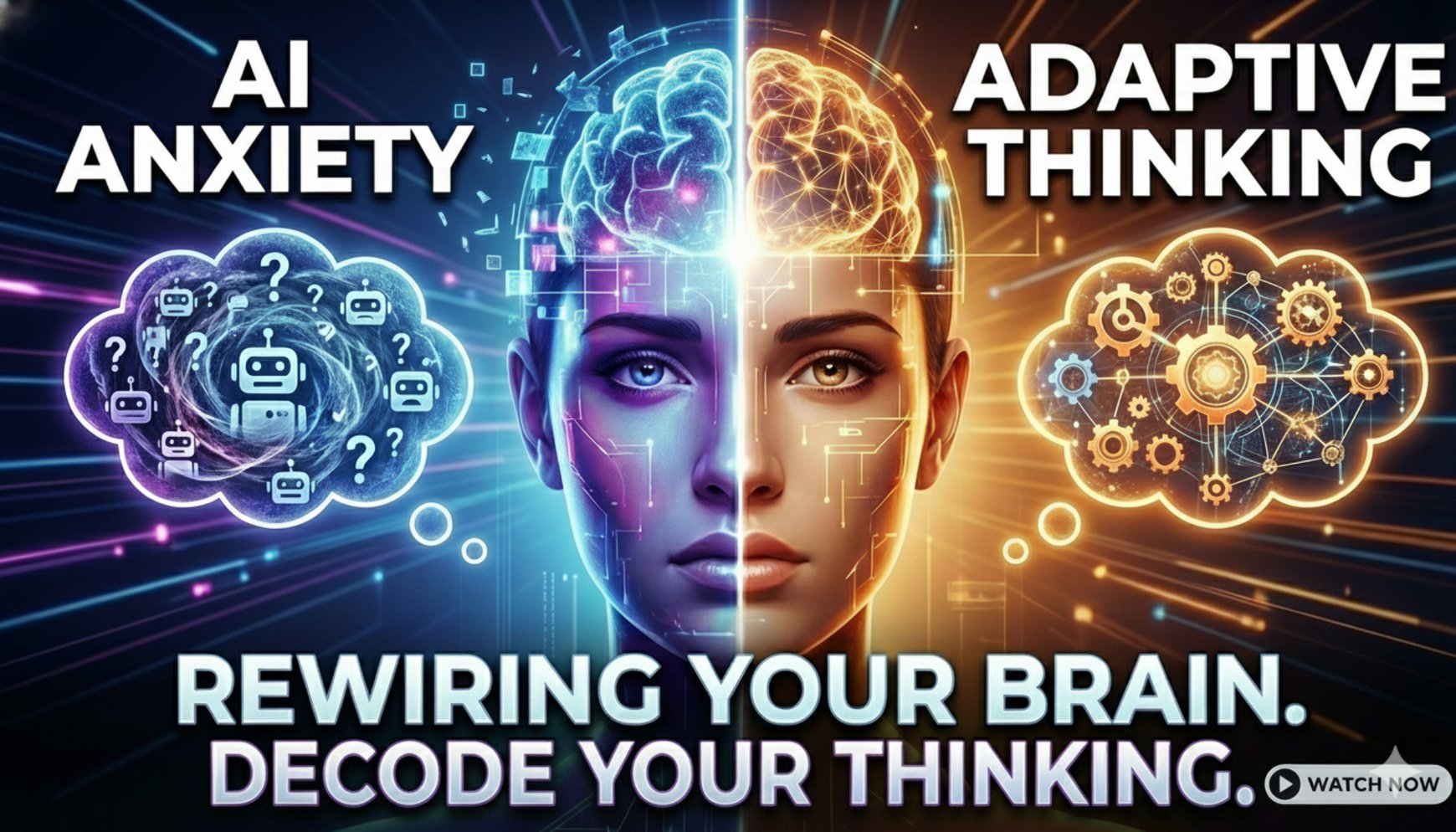
Have you ever felt that subtle unease when someone mentions artificial intelligence replacing job and changing industries?
That’s AI anxiety, a growing psychological response to a world moving faster than our brains were designed to process.
It is not just a technology issue. It is a thinking issue.
You see, within AI anxiety lies a hidden network of thought patterns, mental models, and biases that drive how we perceive, interpret, and react to change.
What Is NeuroAdaptivity?
NeuroAdaptivity is a collection of brain-based skills that creates powerful thinking and action amidst change and uncertainty.
The first skill is Attuning to Change and I talk about this in the video linked in the description. It’s building a radar for expecting and seeing disruption in our life and work.
The second skill of NeuroAdaptivity is Decoding Thought Patterns.
Why Your Brain Treats Uncertainty as a Threat
Let’s take a step back for a moment and talk about our biology. It’s important to remember that our brains are wired to prioritize predictability and safety.
The limbic system, particularly the amygdala, constantly scans for uncertainty and threat. When we encounter something ambiguous, like AI, we experience what neuroscientists call anticipatory anxiety.
The prefrontal cortex, which is our rational brain, tries to interpret this uncertainty. But when information is incomplete or overwhelming, the brain defaults to simplistic patterns of thinking such as fear-based narratives, catastrophic forecasting, and confirmation bias.
Research by Rizkina et al (2025) found that employees experiencing AI-related uncertainty often show elevated stress responses and cognitive rigidity, meaning their mental flexibility decreases right when adaptability is most needed.
AI anxiety is not irrational. It is the brain doing its job too well.
It is protecting us from uncertainty. But in leadership, overprotection quickly turns into paralysis.
In the NeuroAdaptive Leadership™ model, Decoding is using metacognition to become aware of, observe, and then update our own mental operating system.
What Does It Mean to Decode Your Thinking?
To decode means to step outside your thinking so you can understand how you are processing information that leads to further thinking and behavior.
It is the ability to notice the patterns that drive your perceptions, decisions, and behaviors, and to reprogram them when they no longer serve you.
Leaders who fail to decode often fall into bias-driven thinking loops:
- They misinterpret data to confirm their fears. (confirmation bias)
- They assume resistance from others is personal, not neurological and natural.
- They basically repeat outdated behaviors in a new environment.
Leaders who master decoding develop cognitive flexibility, the neural capacity to switch perspectives, hold opposing ideas, and integrate new information without losing clarity or confidence.
Here’s an example from my life. There was a time I realized that when a direct report was giving me insightful information about the company we worked for, I would instantly and without thinking dismiss the information as something I already knew. After doing this several times and realizing it after the fact, I began to think deeply about why I would automatically make a comment stating that I was aware or dismiss the information. Being honest with myself in this decoding process, I realized I had a belief that a leader should be more informed than her or his direct report and that somehow I was not being a good leader if I didn’t know everything that was happening in the company. It was in this decoding process that I challenged my belief and adjusted my perspective. Then I made a commitment to starting a new behavior of listening, asking a question, and then thanking the person for their insight. That’s how decoding works. It’s a process of better understanding and then challenging your default thinking patterns.
The Science Behind Cognitive Flexibility
Let’s ground this in science.
A study by Dajani and Uddin (2015) titled “Demystifying Cognitive Flexibility” explains that flexibility is the brain’s ability to “adapt cognitive processing strategies to face new and unexpected conditions in the environment.”
Neurally, this involves communication between the prefrontal cortex (decision-making and control) and the default mode network (self-referential thinking and mental simulation).
When these networks integrate effectively, we can examine our own thoughts. It’s what neuroscientists call metacognitive monitoring and it helps us make conscious adjustments.
However, under anxiety or fear such as AI-driven uncertainty, this integration weakens. The prefrontal cortex goes offline, the amygdala overfires, and the brain locks into rigid, habitual loops. Basically, sticking to what thinking and behaviors have worked in the past.
That is why decoding is not just an intellectual skill; it is a neural discipline.
It trains your brain to re-engage the prefrontal cortex when the limbic system wants to take over.
How to Build Your Decoding Skill
So, how do we develop our decoding skill?
Practice #1: Cognitive Debriefing
Cognitive Debriefing is a reflective process that helps individuals surface, examine, and reinterpret their internal reasoning after key decisions, conversations, or events.
It is based on the same cognitive flexibility mechanisms discussed by Dajani and Uddin (2015). They showed that flexibility arises from feedback loops that allow the brain to compare prior beliefs with new evidence and then update accordingly.
In leadership, we can simulate that process consciously.
Here’s how Cognitive Debriefing works in practice:
- Trigger Reflection: After a meeting, project, or challenging conversation, pause and ask:
- “What assumptions guided my decisions?”
- “What emotions influenced my interpretation?”
- “Where might I have been overly certain or resistant to feedback?”
- Surface Hidden Models: Identify the mental models behind your reasoning. For example:
- “People resist change”
- “Technology always disrupts before it helps”
- “If I do not have control, something will go wrong”
- “I am not and cannot be in control of everything.”
- Reframe with Evidence: Replace unhelpful narratives with updated interpretations.
For example: “Resistance often means people need more clarity, not control.” - Integrate Feedback: Invite a colleague to share how they saw the same situation.
This activates the anterior cingulate cortex, which is key to conflict monitoring and perspective shifting.
Over time, this practice builds a neural feedback system that mirrors adaptive brain functioning. You are not just reflecting, you are rewiring.
Practice #2: Bias Tracking
The second decoding skill is Bias-Tracking, a method of identifying the subtle belief filters that distort how we interpret information, especially under stress or uncertainty.
Neuroscientific evidence from Harris et al. (2007) provides insight here. In their study, participants evaluating religious and nonreligious beliefs showed activation in the ventromedial prefrontal cortex when affirming beliefs, and amygdala activation when rejecting or feeling threat from contradictory information.
In other words, our brain literally treats belief violation as a form of threat.
When leaders encounter new technology, new strategies, or dissenting opinions, the brain’s automatic response is defensive disbelief.
Bias-tracking helps counteract that.
Here’s how to apply Bias-Tracking in leadership:
- Name the Bias Loop: Identify what kind of bias might be influencing you, such as confirmation bias or fear-based bias.
- “I notice I am dismissing this AI idea because it challenges my expertise.”
- Track Physiological Cues: Notice when your heart rate increases or you feel defensive in conversation. These are signs that the amygdala is hijacking cognition.
- Engage the Prefrontal Cortex: Ask a regulating question such as:
- “What else could be true?”
- “What evidence would make me reconsider my position?”
Harris and colleagues’ findings show that metacognitive awareness, which is recognizing when beliefs feel threatened, reduces the amygdala’s threat signaling and enhances activity in the dorsolateral prefrontal cortex. This region is responsible for cognitive control.
By tracking biases, leaders cultivate what I call neural neutrality, the ability to evaluate ideas without emotional overreaction.
When leaders develop their ability to decode their thinking, they reshape their neural wiring for adaptability. They move from reactive to reflective. From fear-driven to future-focused.
In teams, this manifests as higher psychological safety, greater openness to innovation, and more grounded decision-making during disruption.
The first challenge of the AI era is not mastering technology, but mastering our thinking about technology.
NeuroAdaptive Leadership teaches us that every disruption is an invitation to evolve our mental models.
And decoding is how we accept that invitation.
So, the next time AI headlines make you feel anxious, pause.
Do not fight the anxiety. Decode it.
Ask yourself:
- What story am I telling myself about this change?
- Is it based on fear or on fact?
- What new interpretation could help me grow instead of retreat?
Because leadership in the age of AI is not about knowing all the answers. It is about having the mental flexibility to keep decoding, learning, and adapting faster than the environment changes.
Key Takeaways
- AI anxiety is a thinking problem before it is a technology problem. The discomfort comes from how your brain interprets uncertainty, not from the tools themselves.
- Under uncertainty, the amygdala scans for threat and the prefrontal cortex loses influence, which produces rigid thinking instead of flexible thinking.
- Decoding is the use of metacognition to notice, examine, and update the thought patterns driving your decisions.
- Cognitive Debriefing builds flexibility by having you surface and reinterpret your internal narrative after a charged moment.
- Bias Tracking builds neural neutrality, the ability to evaluate an idea without treating disagreement as a threat.
Research Citations
- Dajani, D. R., & Uddin, L. Q. (2015). Demystifying cognitive flexibility: Implications for clinical and developmental neuroscience. Trends in Neurosciences, 38(9), 571–578.
- Harris, A., Kaplan, J. T., Curiel, A., Bookheimer, S. Y., Iacoboni, M., & Cohen, M. S. (2007). The neural correlates of religious and nonreligious belief. PLoS ONE, 2(12), e918.
- Rizkina, A. T., Hidajat, H. G., & Farida, I. A. (2025). Job-related anxiety in the age of artificial intelligence: A sytematic review of workplace dynamics. Formosa Journal of Multidisciplinary Research, 4(8), 3965–3976.