
 For organizations booking Dr. Jason Jones
The program ends. The behavior change is just getting started.
ActionKeeper™ turns your event with Dr. Jason Jones into four weeks of guided action for every person in the room — and gives you a dashboard that shows whether it worked.
Most presentations are forgotten. Yours doesn’t have to be.
You are investing real budget to put a speaker or facilitator in front of your people. What happens in the days afterward is what decides whether that budget did anything at all.
of new material is forgotten within days when nothing reinforces it. The classic “forgetting curve” was confirmed again in a 2015 replication study.
Ebbinghaus; replicated by Murre & Dros, PLOS ONE, 2015
the result when training is followed by coaching. Training alone raised manager productivity 22%. Training plus follow-up coaching raised it 88%.
Olivero, Bane & Kopelman, Public Personnel Management, 1997
ActionKeeper™ builds that follow-through into the event itself: a commitment written down in the room, a coaching conversation every week, and progress you can actually measure — running automatically for four weeks after Dr. Jones leaves the stage.
What ActionKeeper™ is
A four-week coaching and accountability program included with Dr. Jason Jones’ keynotes, workshops and training. At the event, participants scan a QR code, write down one commitment in their own words, and rate where they are today. For the next four weeks each person gets one short check-in with an AI coaching guide that responds to what they actually wrote. You get a dashboard showing participation, measured growth, and the themes your people are working through — and an executive summary at the end.
No software to install. No accounts for IT to manage. No passwords for anyone.
Why four weeks, and not longer? Because follow-through drops off sharply past four weeks — a longer program reliably produces less of it, not more. The length is fixed, and nobody is asked to choose. Four weeks is long enough for a behavior to survive a bad week, and short enough that people finish.
What your people get, step by step
At the event: scan, commit, begin
In the closing moments of the keynote, participants scan a QR code on screen. In about two minutes they write down one behavior they are committing to, name the first action they will take, rate where they are today on a 0–10 scale, and give you a quick read on the session itself.
A welcome email arrives before they leave their seat, with their commitment in writing and a link straight into their own private dashboard.

One five-minute check-in a week
Every Tuesday, a short email invites each person into that week’s check-in. The same four questions every week, so it becomes a rhythm rather than a new task: what they actually did, what helped or got in the way, what came of it, and what is next.
If they have not checked in by Thursday, they get one reminder. One — and it stops as soon as the next week comes around.
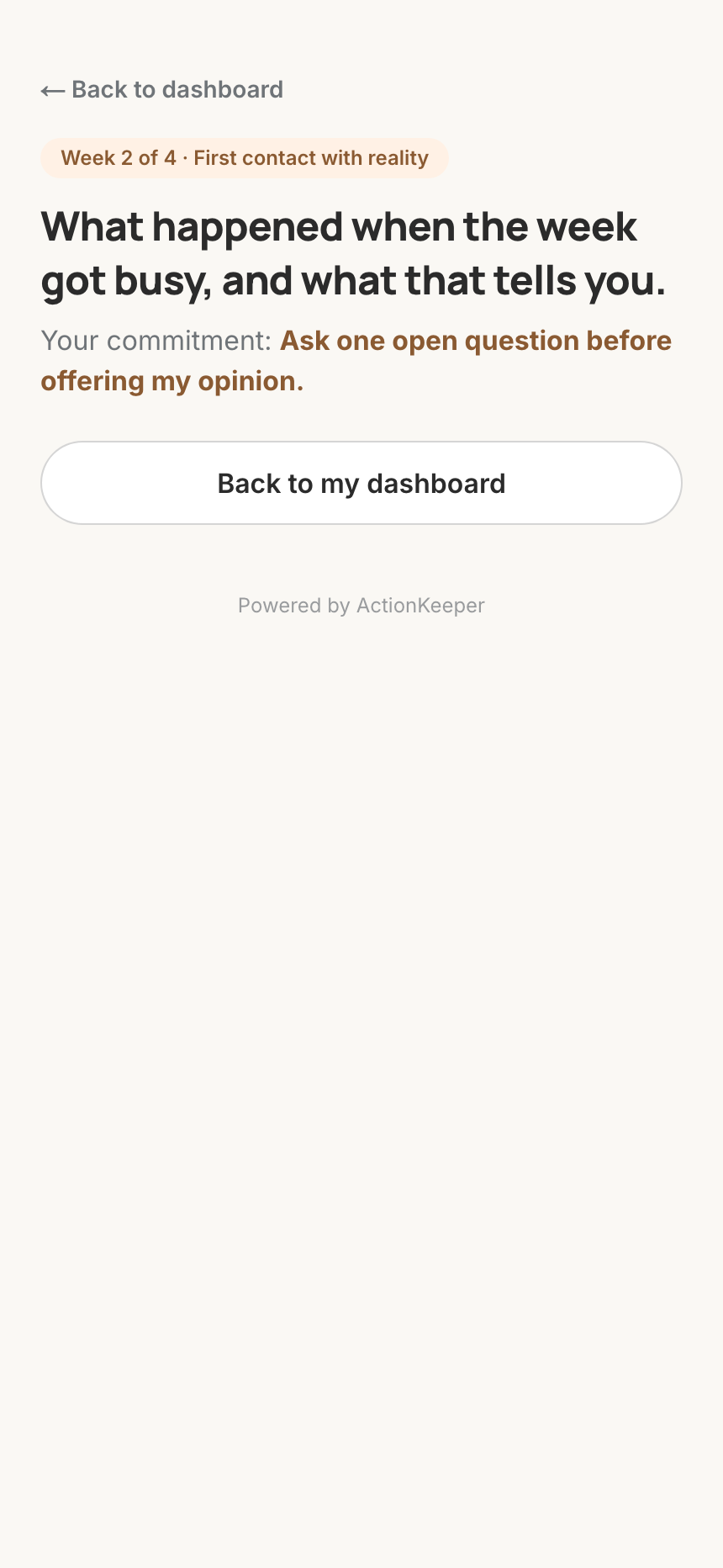
Progress they can see
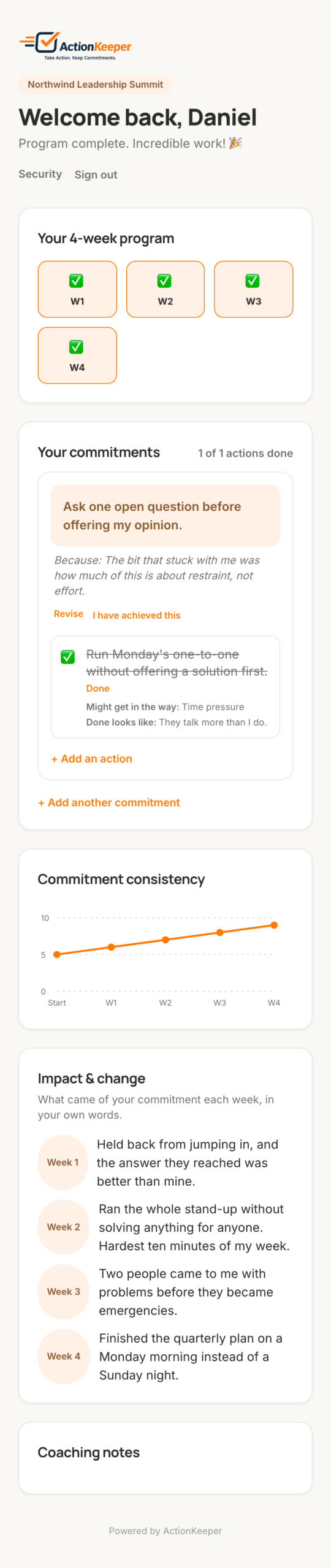
Each participant’s dashboard keeps their commitment front and center, tracks their score from the day of the event through to the end, keeps a record of what has actually changed, and pins this week’s single action.
At the end of week four they receive a personal summary: what they committed to, what changed, and what is worth keeping.
The check-in email. Same day every week, for four weeks.
One reminder, only for people who have not checked in yet.
Monday is when a weekend’s inbox gets triaged. Friday is when people are already gone.
Every check-in becomes a real coaching conversation
This is what separates ActionKeeper™ from a follow-up email series. After each check-in, the coaching guide responds to what that person actually wrote — naming the specific behavior they described rather than quoting it back at them — and asks one question worth sitting with.
They answer, and the exchange closes with one concrete action for the week ahead. Two exchanges, never more. And when somebody’s plan for the coming week is vague, the guide supplies a specific action rather than handing the question back.
The coaching is grounded in behavioral and performance psychology — drawn from Dr. Jones’ published work and the established research behind it — on how habits form, what actually motivates people, how barriers get beaten, and what makes a new behavior survive contact with a busy week.
- It responds to what they wrote, not to a template
- One question, then one specific action
- A missed week is treated as information, not failure
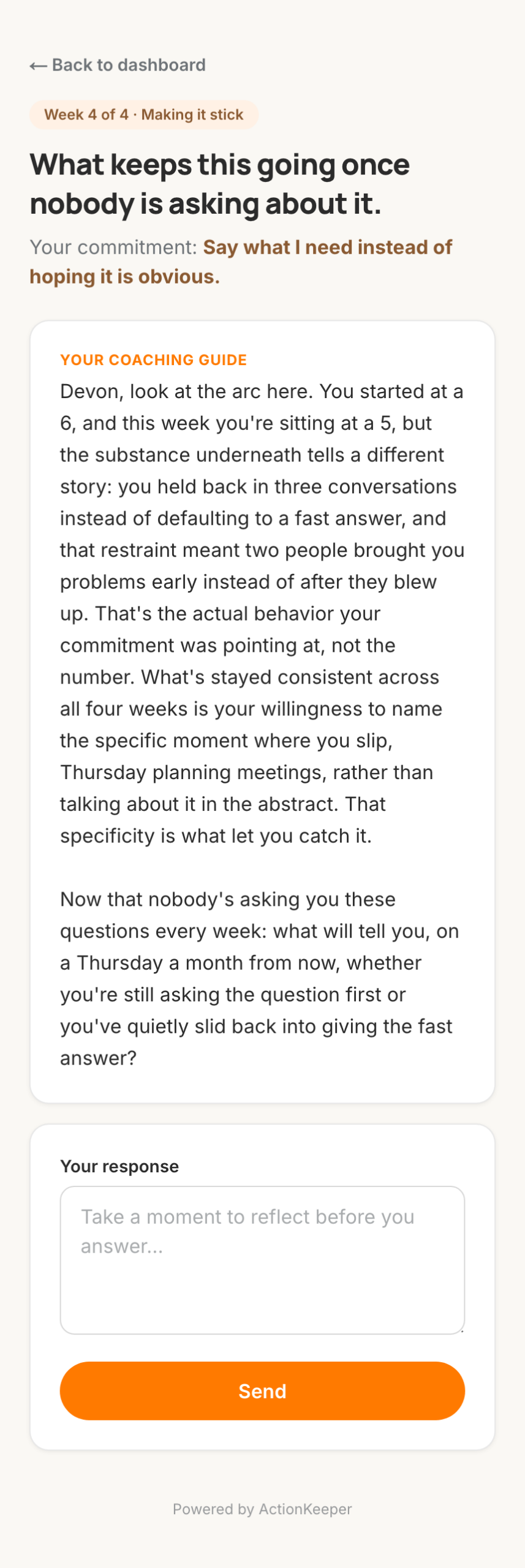
An exchange from a demonstration program.
Your dashboard: proof, not anecdotes
While your people build habits, the evidence accumulates on a dashboard built for the person who signed the contract.
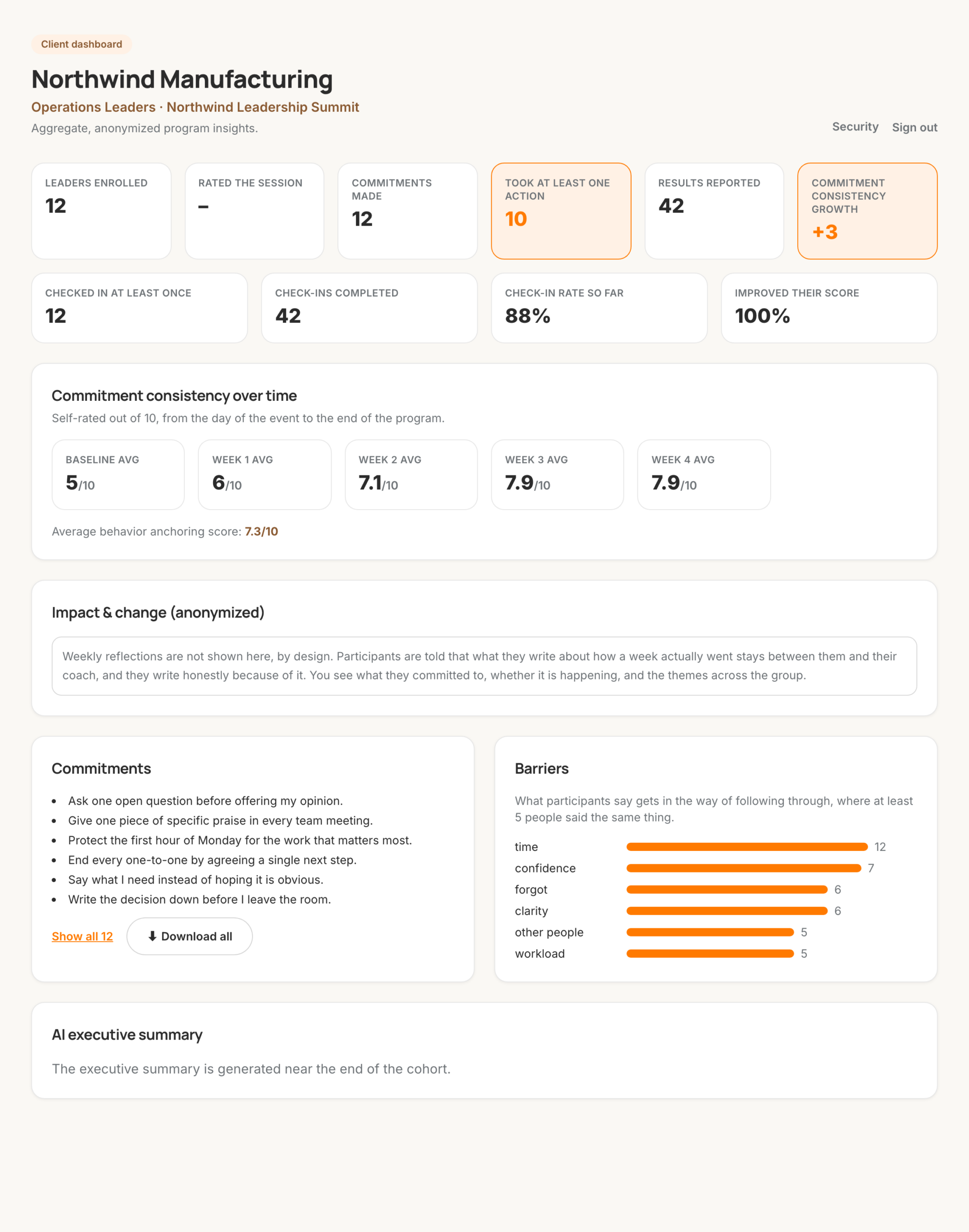
A sample dashboard, built from demonstration data.
What you’ll see
- How many enrolled, and how consistently they are checking in
- How many have taken at least one real action — asked directly, not inferred
- Commitment consistency from the day of the event through week four
- The commitments your people made, in their own words
- The barriers they name as getting in the way
What you’ll walk away with
- An executive summary at program end: participation, evidence of change, and what to do next
- A full data export for your own reporting
- A concrete answer to “was that event worth it?”
Privacy is the design, not a setting. What your people write each week about how it actually went is never shown to you. You see what they committed to, whether it is happening, and the themes across the group.
And nothing written appears at all unless at least five people said the same thing — a floor enforced by the system itself, not by anyone remembering to switch it on. Below five participants you get counts and scores and no free text whatsoever.
That privacy is exactly what makes people honest, and honest reflection is what produces the change you are paying for.
Zero lift
- Dr. Jones’ team sets everything up before the event
- Your only job on the day: leave the QR code on screen for sixty seconds
- No software to install, no accounts for IT, no passwords for anyone
- Participants can stop the emails at any time, in one click
- Nobody is added without scanning the code themselves
- Open to adults only — 18 and over
Before you decide
How much work is this for our team?
Almost none. Dr. Jones’ team creates your program before the event and the QR code goes on his closing slide. Everything after that runs on its own. Your part is opening your dashboard whenever you want to see where things stand.
What does it ask of each participant?
About two minutes to register at the event, then one five-minute check-in a week for four weeks. Each check-in ends with one small, specific action for the coming week. It is built for busy calendars, not homework.
Can we see individual employees’ answers?
No. What somebody writes each week about how it actually went stays between them and their coaching guide. Your dashboard shows participation, scores, the commitments people made, and the themes across the group — with no names attached.
There is also a floor: nothing written appears unless at least five people said the same thing, and it takes five separate people, not five entries. Below five participants you get counts and scores and no free text at all. That is enforced by the system rather than by a setting somebody has to remember.
How is this different from a follow-up email series?
Emails talk at people. ActionKeeper™ works with them: each person makes a written commitment, reflects on it weekly, gets a coaching response to what they actually wrote, and watches their own progress. And unlike an email series, it hands you evidence at the end.
Is the coaching just generic AI?
It is an AI coaching guide, and it says so to participants rather than pretending otherwise. What makes it different from a chatbot is what it is built on and what it is allowed to do: it is grounded in behavioral and performance psychology from Dr. Jones’ published work and the research behind it, it responds to the specific thing that person wrote, and every exchange ends with one concrete action rather than more conversation.
Why four weeks and not longer?
Because longer programs finish worse. Follow-through drops off sharply past four weeks, so a six- or eight-week program reliably produces less change, not more. Four weeks is long enough for a new behavior to survive a bad week and short enough that people actually complete it.
What happens when the four weeks end?
Participants complete a final reflection and receive a personal summary. You receive an executive summary covering participation, evidence of change and recommended next steps, plus a full data export. It is also the natural moment to decide what comes next for your team.
What about people who would rather not take part?
Nobody is enrolled without scanning the code themselves, and anyone who changes their mind can stop the emails in one click from any message. Taking part is a choice each person makes in the room.
Book the keynote they will still be acting on in week four.
ActionKeeper™ comes with keynotes, workshops and training programs by Dr. Jason Jones. Tell us about your event and we will show you what your dashboard could look like.
Talk to Dr. Jones About Your Event
ActionKeeper™ and NeuroAdaptive Leadership® are trademarks of Dr. Jason Jones.